
The Evidence Chain
Deception PointThis flow follows Rachel and the scientists as they test each apparent proof of extraterrestrial origin and discover how context made weak evidence look conclusive.
increasing Bearing strength in each event
 decreasing
Bearing strength in each eventdecreasingThe First Case for Space
The First Case for Space
A persuasive specimen
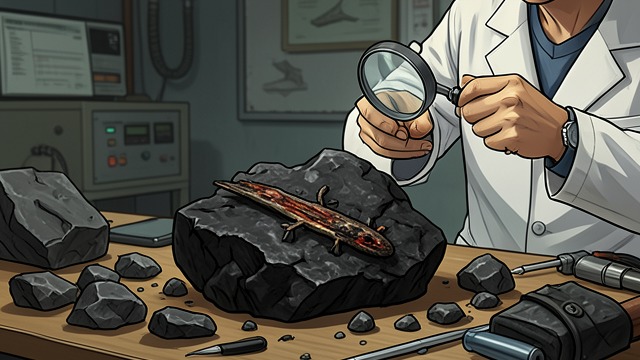
Corky Marlinson shows Rachel a fossil embedded in a dark, unusually dense rock. The sample has chondrules and a charred exterior, features that seem to confirm meteoritic origin.
Multiple scientists and tests reinforce the interpretation. The fossil itself appears to be a genuine organism, and its presence makes the claim of extraterrestrial life compelling.
Confidence from convergence
Each piece of evidence appears to support the others: the rock’s composition, the fossil, its burial in old ice, and its supposed association with a documented impact.
The apparent convergence is powerful, but it depends on treating the discovery site as natural and untouched.
The Water Anomaly
The Water Anomaly
An unexpected glow
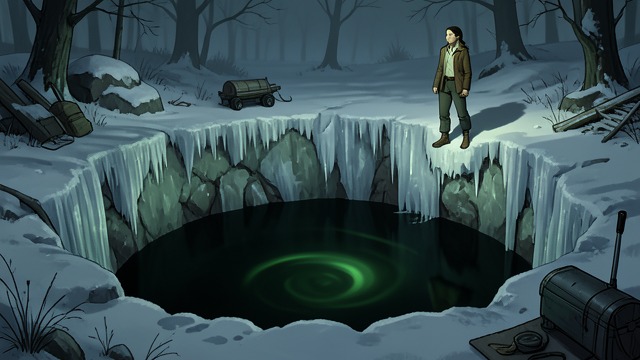
Tolland observes green, pulsing light on the surface of the extraction pit. He identifies it as bioluminescent plankton that should not inhabit sealed freshwater from a glacier.
Norah initially rejects the observation because her ice cores show no cracks and because the water level does not behave as if seawater is flowing into an open fissure.
A new explanation required
Testing confirms brine and marine organisms in the pit. Rachel proposes that organisms might have been trapped in frozen brine within the ice and revived by the extraction heat.
The hypothesis is plausible but cannot account for the distribution of the brine, forcing the group to test the ice directly rather than settle for a convenient explanation.
The Radar Cross-Section
The Radar Cross-Section
A test of the ice
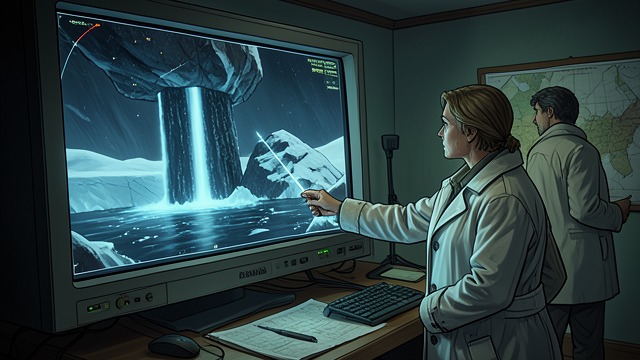
Norah takes a ground-penetrating radar scan to settle the dispute over brine pockets. The scan identifies Ming’s body in the pit and a deep column of sea ice beneath the meteorite.
The image reveals an artificial route from the ocean below, showing that the rock did not arrive through an ancient fall onto the glacier.
The setting collapses
The radar does not disprove that the rock contains fossils or unusual inclusions. It disproves the claim that the rock’s apparent burial proves its age and natural placement.
The distinction forces Rachel and Tolland to re-examine every conclusion that had depended on the location being authentic.
The Oceanic Alternative
The Oceanic Alternative
Reconsidering the fossils
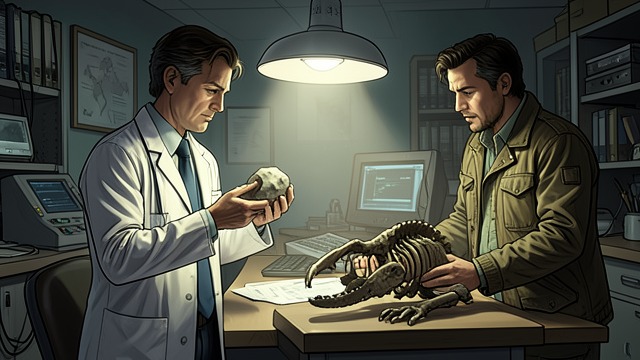
Rachel asks Tolland to assess the rock without being told that it is a meteorite. He admits that the fossil could represent an ancient Earth species, particularly one adapted to deep water.
The oversized arthropods initially seemed to require a low-gravity planet. Tolland explains that water can support large bodies, making a marine origin possible.
A missing comparison
The possibility of a terrestrial source changes how the scientists interpret the fossil, but the supposed meteoritic features still seem to support the original claim.
Rachel’s null-start method directs attention to the assumptions behind each test, especially the reported nickel range and the apparently clean fusion crust.
Laboratory Reversal
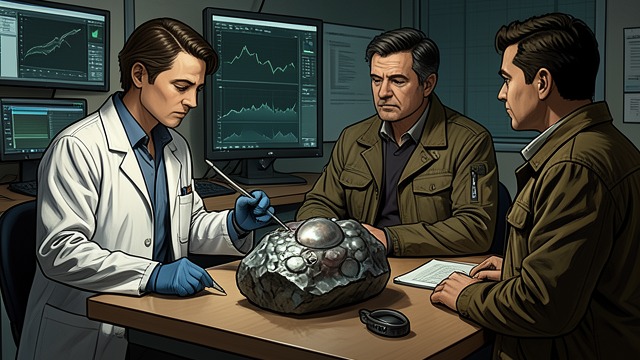
Laboratory Reversal
The resemblance becomes evidence
Tolland’s marine database identifies Bathynomous giganteus, a deep-ocean isopod resembling the fossils in the rock. Xavia explains that ocean pressure can produce chondrule-like structures in rocks from the Mariana Trench.
A microprobe test finds the unusual titanium-to-zirconium ratio expected in the deep-sea material and inconsistent with the claimed meteorite.
The chain breaks
The insertion shaft, marine fossils, pressure-formed inclusions, and hydrogen-rich burn all point toward a manufactured object built from Earth materials.
The scientists conclude that their earlier confidence came from a chain of evidence whose key assumptions had been supplied by the people staging the discovery.
The first hours at the Arctic camp
After the meteorite is lifted
Night on the glacier
On the flight toward the Goya
Near dawn aboard the Goya
